

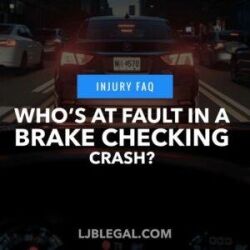
You are driving down the road, traffic is moving normally, then suddenly the driver in front of you slams on the brakes for no reason. You barely have time to react before the crash happens.
Now the insurance company says you are at fault because you hit the other vehicle from behind.
That feels unfair because sometimes it is.
In Louisiana, the rear driver is often presumed responsible in a rear-end accident. But a brake-checking crash is not always a normal rear-end collision. When another driver intentionally brakes to scare, punish, or intimidate someone behind them, fault can shift.
A Louisiana car accident lawyer can investigate whether aggressive driving, road rage, or reckless behavior played a role in the crash. Evidence like dashcam footage, witness statements, and traffic camera video can make a major difference when proving fault.
Understanding who is at fault in a brake-checking accident in Louisiana depends on the evidence, the actions of both drivers, and how Louisiana comparative fault laws apply to the crash.
What Is Brake Checking?
Brake checking happens when a driver intentionally slams on the brakes to force another driver to stop suddenly. It often happens during road rage situations or when a driver feels angry about being followed too closely.
Unlike a normal stop for traffic or a road hazard, brake checking usually has no legitimate reason behind it.
Examples of brake checking include:
- Cutting in front of another vehicle and braking hard
- Repeatedly tapping the brakes to intimidate another driver
- Slamming on the brakes after feeling tailgated
- Trying to “teach another driver a lesson”
Brake checking is dangerous because drivers need time and distance to stop safely. At highway speeds, even a brief delay can lead to a serious collision.
In some situations, brake checking may qualify as reckless driving under Louisiana law.


Why Does Louisiana Usually Blame the Rear Driver?
Louisiana law generally assumes the rear driver caused a rear-end accident. Drivers are expected to leave enough space to stop safely if traffic slows or stops unexpectedly.
Insurance companies rely heavily on this rule because it makes claims easier to deny.
Under Louisiana Revised Statute 32:81, drivers cannot follow another vehicle more closely than is reasonable and prudent.
This creates what lawyers call a rebuttable presumption.


We DO THE RIGHT THING
The correct choice – always – is to do the right thing.
FREE Confidential Case Review (985) 240-9773What Is a Rebuttable Presumption?
A rebuttable presumption means the law starts by assuming something is true unless evidence proves otherwise.
In most rear-end crashes, Louisiana law starts with the assumption that the rear driver was following too closely and caused the collision.
But that assumption can be challenged.
If evidence shows the front driver acted recklessly by brake-checking, cutting someone off, or driving aggressively, fault may shift partly or fully onto the front driver.
This is why evidence matters so much in brake-checking accidents.


We ARE TRANSPARENT
We don’t play games and we don’t hide the ball.
FREE Confidential Case Review (985) 240-9773How Is Fault Determined in a Brake-Checking Crash?
Fault in a brake-checking crash depends on the actions of both drivers and the available evidence.
Louisiana follows a modified comparative fault system. This means multiple drivers can share responsibility for the same crash.
Even if the rear driver shares some blame, they may still recover compensation if the other driver also acted recklessly.
Did the Front Driver Brake Without a Valid Reason?
One of the biggest questions is whether the front driver had a legitimate reason to stop.
Stopping for traffic, an animal, debris, or an emergency is normal. Slamming on the brakes out of anger is different.
If there was no road hazard or traffic issue, the sudden stop may support a brake-checking claim.
Was the Rear Driver Following Too Closely?
Even if brake checking occurred, the rear driver may still share responsibility if they were tailgating, speeding, or driving aggressively.
For example:
- The front driver may be 70% at fault for brake checking
- The rear driver may be 30% at fault for following too closely
Under Louisiana comparative fault laws, compensation is reduced by the injured person’s percentage of fault.
Was There Aggressive Driving or Road Rage?
Aggressive driving behavior often plays a major role in brake-checking accidents.
Evidence of road rage may include:
- Swerving between lanes
- Speeding up and slowing down repeatedly
- Yelling or making gestures
- Cutting off another driver
- Intentional sudden braking
These actions can help show the crash was caused by reckless behavior instead of an unavoidable accident.
What Evidence Helps Prove Brake Checking?
Brake-checking accidents are often difficult to prove because they happen quickly.
Insurance companies usually try to treat them like ordinary rear-end collisions.
Strong evidence may include:
- Dashcam footage
- Traffic camera video
- Business surveillance footage
- Eyewitness statements
- Vehicle black box data
- Accident reconstruction analysis
Dashcam footage is often the strongest evidence because it can show the front driver braking suddenly without a reason.


We ARE COMPASSIONATE
Emotionally intelligent listeners with positive attitudes.
FREE Confidential Case Review (985) 240-9773Why Are Brake-Checking Cases Hard to Prove?
Many brake-checking accidents turn into one driver’s word against another’s.
The front driver rarely admits they intentionally caused the crash. Instead, they often claim:
- Traffic slowed suddenly
- They saw debris in the road
- An animal crossed the highway
- The rear driver was distracted
Police reports may also fail to mention aggressive driving because officers usually arrive after the collision happened.
Without video footage or witnesses, insurance companies often fall back on the rear-end presumption and blame the rear driver automatically.
What Should You Do After a Brake-Checking Accident?
The steps you take after the crash can affect your health, your claim, and your ability to prove fault.
- Call the police immediately
- Take photos of vehicle damage and the roadway
- Look for witnesses before they leave
- Save dashcam footage right away
- Get medical care as soon as possible
- Avoid admitting fault
- Be careful speaking with insurance adjusters
Many drivers accidentally damage their claims by saying things like:
- “Maybe I was following too close.”
- “I could not stop in time.”
- “I did not see them brake.”
Insurance adjusters are trained to look for statements they can use against injured drivers.
Can You Sue Someone for Brake-Checking in Louisiana?
Yes. If another driver’s intentional or reckless behavior caused the accident, you may be able to pursue compensation for:
- Medical bills
- Lost wages
- Pain and suffering
- Vehicle repairs
- Future medical treatment
The challenge is proving what actually happened before the collision.
That is why serious brake-checking cases often require experienced legal representation and a full investigation.
How LJBLegal Helps After a Brake-Checking Accident
If you are like most people, you have never hired a lawyer before. And that can be a little scary.
After a crash, you may be dealing with injuries, missed work, medical bills, and constant calls from insurance companies.
Loyd J Bourgeois Injury & Accident Lawyer (LJBLegal) helps injured people across Louisiana investigate difficult car accident cases, including crashes involving aggressive driving and brake checking. We search for evidence and witnesses, including sending letters of preservation for video evidence.
Sometimes cases settle quickly. Sometimes insurance companies refuse to be fair. If your case goes to court, you want a team prepared to fight for the full story, not just accept the insurance company’s version of events.
Serious accident cases require preparation, experience, and attention to detail. LJBLegal works to gather evidence, challenge unfair fault claims, and help clients pursue the compensation they deserve.
There are no upfront costs, and you pay nothing unless LJBLegal recovers money for you.
Talk to LJBLegal About Your Louisiana Brake-Checking Wreck
Do not assume you are automatically at fault just because your vehicle hit another car from behind.
Brake-checking accidents are more complicated than ordinary rear-end crashes, and the insurance company’s first decision is not always the right one.
If another driver’s reckless behavior caused your injuries, LJBLegal can help you understand your rights and your options. Call us now at 985-240-9773


